Game provider lobby visibility has two sides: where your studio stands against the market, and where your titles sit today. How to measure both of them.
Game provider lobby visibility needs two views, not one
Picture an account manager at a slot studio, the week before a quarterly call with an operator. She opens the operator’s site, then the next one, then the next market. Half a day later she has a list of where the studio’s titles sit. On one site, the studio’s best title has moved from the first row to page two. She does not know when it moved. She does not know if other studios moved with it, or only hers. And she has nothing to show the operator except her own notes.
This is how game provider lobby visibility is measured in most studios today: by hand, a few times a year, one site at a time. This article looks at why that method cannot answer the questions a studio actually has, what it costs, and what a complete view looks like.
Why manual lobby checks cannot benchmark a game studio
Players open the games they see first. A title in the first row of a casino homepage earns differently from the same title three rows down. That is why placement matters to a studio as much as the game itself, and why account managers spend hours checking it.
So why does the check still happen by hand?
Because a lobby is not one thing. Every operator arranges its own rows. Each market can show a different set of games. The mobile view is often not the same page as the desktop view. And the arrangement changes all the time: new releases rotate in, promotions take over the top rows, and some categories even carry a provider’s name, often a sign of a commercial arrangement.
A hand check captures one moment of that picture. In practice it has three blind spots:
- it sees one site at a time, never the whole market at once,
- it sees one day, with no record of when a position changed,
- it sees your titles only, with no view of where other studios moved on the same day.
The third point matters more than it looks. If your title dropped two rows, is that about your title, or did the operator push a competitor’s launch into the rows above it? From one hand check, there is no way to tell.
What a quarter of hand checks costs an account team
Take an illustrative example and swap in your own figures. A studio works with 10 operators in 3 markets and tracks 5 rows on each site, desktop and mobile. That is 300 lobby views per round. At about 2 minutes per view to open, scroll, find the titles and write down the positions, one round takes about 10 hours. Most teams can afford it once a quarter. The hours are the smaller part of the cost. The larger part is the gap between rounds.
Suppose a title brings €600 of GGR a day on one operator site while it sits in the first row, and €250 a day after it moves to page two. If the move happens a week after the last check and nobody sees it for 60 days, that is about €21,000 of difference on one title, on one site. (60 × €350.) All of these figures are illustrative. The shape of the math is what matters: revenue gap per day × days until someone notices. A check once a quarter makes the second number as large as it can be.
And there is one more cost. Some studios pay for placement. If an operator does not deliver the position that was agreed, a studio with a dated record can raise it. A studio with a memory of what the page looked like last month cannot.
Two questions every benchmark has to answer
A complete view of lobby visibility answers two different questions. They need different data, so it helps to keep them apart.
| Where does my studio stand against the market? | Where do my titles sit today? | |
| Scope | the whole market, every studio | your title only |
| Depth | casino homepages | the lobby rows you choose |
| Time | how the market changes from one edition to the next | how your positions change from one day to the next |
| What is gives you | context – your share next to everyone | proof – the date, the position and screenshot |
A market view alone tells you where you rank, but not what happened to a single title on a single site last Tuesday. A daily view of your own titles tells you exactly that, but nothing about the studios around you.
PlayPatrol answers each question with a different tool.
Open Patrol: where your studio stands in the market
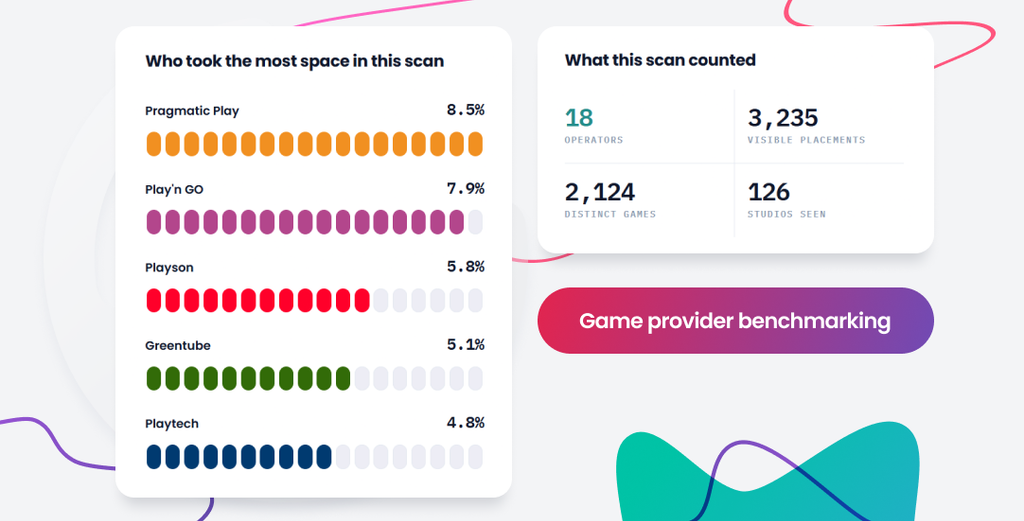
Open Patrol is a free public report by PlayPatrol. It records which studios the biggest casino operators put in front of players on their homepages, market by market. Three things make it useful for benchmarking:
- It covers every studio, not only yours. You see your share of homepage space next to everyone else’s, with casinos and studios named.
- It is evidence first. Every figure is a count, and every count sits beside the capture it was read from, with the date of measurement.
- It compares like with like. Changes between editions are counted on the same set of casinos, so a studio does not “grow” just because new casinos joined the report.
Open Patrol answers the market question. It is a snapshot of each market at the date of measurement, not a daily watch, and it looks at homepages, not the full lobby.
Visibility Patrol: where your titles sit, every day
Visibility Patrol answers the second question. It opens the operator sites you name the way a player does, and records where each of your titles sits in the rows you choose.
What that looks like in practice:
- A check every 24 hours, per casino and per market. The mobile view is checked in a separate visit, the way a player on a phone sees the page.
- A screenshot behind every position: your title marked, the games around it visible, with the market, the date and the time.
- Alerts on the moves that matter. You set the lowest position you accept for each title. When a title falls below it, you get an alert in e-mail, Slack, Teams and more.
- History of at least 90 days, with CSV export, so a slow drop is as visible as a sudden one.
- Your whole portfolio. New titles are added at no charge, and there is no limit on users.
The operator call starts with a screenshot, not a guess
Go back to the account manager from the start. With both views in place, her week before the call looks different.
From Open Patrol, she knows where the studio stands in that market, and whether the operator moved other studios on its homepage at the same time.
From Visibility Patrol, she knows the exact day the title left the first row, and she has the screenshot from that morning.
The call with the operator starts with a date and a picture, not with “we have a feeling something changed.” If the studio pays for that placement, the conversation is about the record, not about memory. And the half day of clicking goes back to work that needs a person.
For the head of distribution, the same data answers a planning question – Which operators give the studio’s titles the space they need, and which do not.
Game provider lobby visibility: questions studios ask
Is Open Patrol free?
Yes. Open Patrol is a public report, free to read, with named casinos and named studios.
Does Visibility Patrol show other studios’ data?
In every lobby view you see your titles among the other games in that row, including the ones directly above and below yours. The market-wide comparison across all studios is what Open Patrol is for.
What counts as a lobby row?
One row of games on a casino page. Top, Hot and New Games are everyday examples. You choose which rows the patrol watches.
How often is a row checked?
Once every 24 hours. Each check records the position of every tracked title and stores the screenshot.
How long is the history kept?
At least 90 days, with CSV export at any time.
What do I need to send to start?
A list of your titles, plus the casinos, markets and rows to watch. New titles can be added later at no charge.
Two views, one conversation
The account manager from the start did not lack effort. She lacked two things: a view of the market around her titles, and a record of what happened to them between her checks.
How can I check my studio’s online visibility?
You can use the free OpenPatrol report. It shows the visibility of game studios and game providers in the iGaming sector across selected markets.
2026 iGaming report for game studios
OpenPatrol is a report that presents the latest results achieved by game studios in 2026. The report is free and designed for game studios.
Where can I find the best game studios in 2026?
OpenPatrol is a place where you can find the best game studios in selected markets. You can compare their positions, changes over time, and how often they release new games in each market.
Open Patrol shows the market. Visibility Patrol shows your titles. The next operator call needs both.